





For years, decentralised finance was mostly discussed within cryptocurrency communities. It was associated with experimental applications, unfamiliar terminology and financial products that seemed far removed from everyday banking. Today, that picture is changing. DeFi has developed into a broad ecosystem covering lending, trading, payments, liquidity provision and other financial activities, while traditional financial institutions are also experimenting with blockchain-based infrastructure.
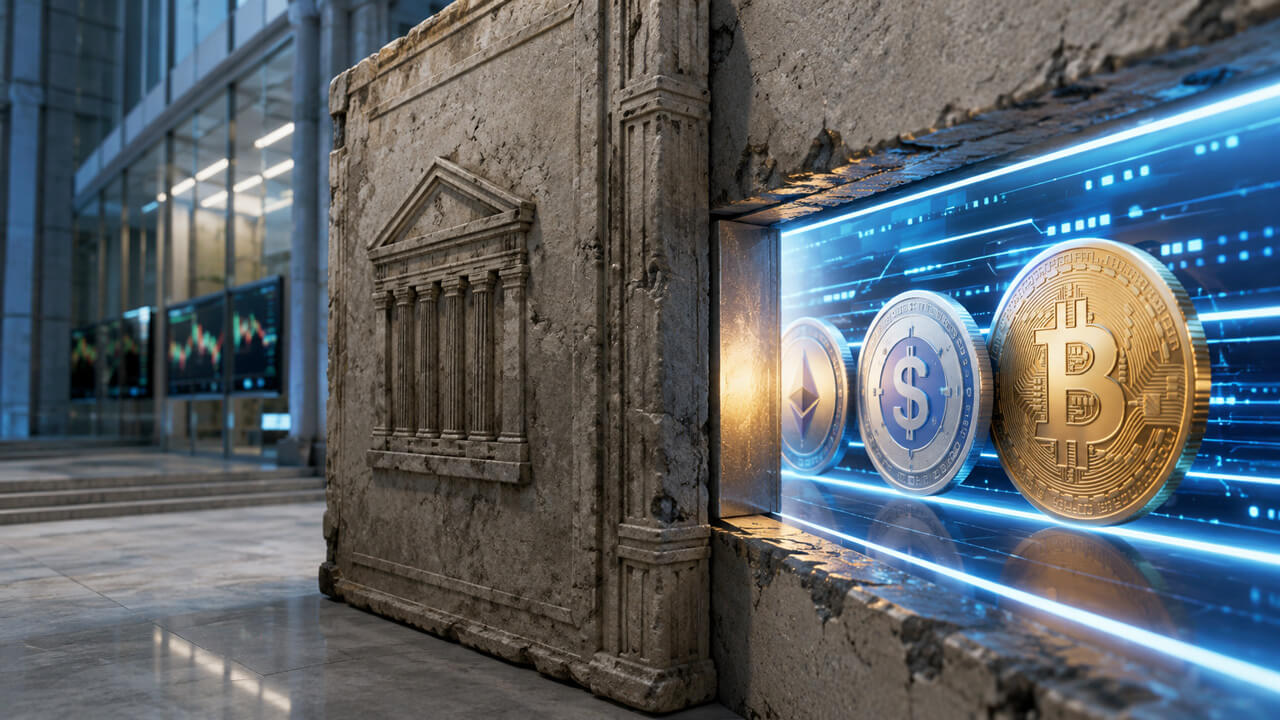
That does not mean that DeFi is about to replace German banks or the European financial system. The reality is much more interesting. DeFi and traditional finance are increasingly exploring some of the same ideas from completely different directions. Banks are looking at tokenisation and blockchain settlement, while DeFi developers are trying to recreate financial services through open software and smart contracts. The European Commission itself now considers decentralised finance part of the wider digital-asset landscape alongside cryptocurrencies, stablecoins and tokenised financial assets.
For people in Germany, the important question is therefore not whether one system will suddenly eliminate the other. It is whether parts of DeFi can become useful enough, secure enough and understandable enough to operate alongside traditional financial services.
What Traditional Finance Does Well
The German financial system has something that DeFi does not easily reproduce: established institutions with clearly defined responsibilities.
When a customer opens a bank account, applies for a loan or makes a payment, there is normally a regulated organisation responsible for providing the service. There are procedures for resolving disputes, identifying customers, protecting accounts and complying with financial rules. Customers may not think about these systems every day, but they are an important part of how modern finance operates.
Traditional finance also benefits from decades of infrastructure. Banks, payment networks, securities markets and financial regulators have developed processes for handling enormous amounts of money. That infrastructure can sometimes feel slow or complicated, but it provides a level of familiarity that is difficult for new technologies to reproduce immediately.
DeFi approaches the same problems differently. Instead of placing every financial function inside an institution, it can use blockchain networks and smart contracts to automate parts of the process. Ethereum describes DeFi as an open financial system built around cryptocurrencies and smart contracts, where users can access services such as borrowing, trading and other financial activities without relying on traditional intermediaries in the same way.
Neither model is perfect.
That is what makes the comparison worthwhile.
Where DeFi Has an Interesting Advantage
The most distinctive feature of DeFi is its programmability.
A traditional financial product normally has to be built and maintained by an organisation. DeFi applications can be constructed from smart contracts that interact with one another on a blockchain. Developers can take existing protocols and create new applications around them, producing what is sometimes described as “money legos.”
This composability can make financial innovation faster.
For example, a developer could build an application that uses a decentralised exchange for trading, a lending protocol for credit and a stablecoin for settlement. Each component can potentially interact with the others without requiring a separate institution to build the entire system from scratch.
This is one reason DeFi can develop quickly.
It also explains one of its biggest risks.
When multiple protocols are connected, a problem in one component can potentially affect applications built on top of it. More flexibility therefore creates more complexity, and users need to understand that an apparently simple DeFi application may depend on several underlying systems.
Why Tokenisation Could Connect Both Worlds
Tokenisation may be one of the areas where DeFi and traditional finance come closest together.
The basic idea is to represent an asset or financial claim using blockchain-based tokens. These could potentially represent securities, funds, bonds, money-market instruments or other forms of value, depending on the legal and technical structure.
The European Commission has highlighted tokenisation and distributed-ledger technology as areas with potential to improve financial-market infrastructure and settlement.
This is significant because tokenisation does not require traditional financial institutions to disappear.
A bank, asset manager or financial-market operator could potentially issue or manage tokenised assets while using blockchain infrastructure to improve certain processes.
At the same time, DeFi protocols could provide additional infrastructure around those assets, provided the legal and technical requirements allow it.
This creates a possible middle ground between decentralised applications and conventional finance.
The Biggest Barrier May Be Trust
DeFi is often described as trustless, but that phrase can be misleading.
Users may not need to trust a bank to execute a smart contract in the traditional sense, but they still need to trust several things. They need confidence that the code works as intended, that the blockchain remains operational, that price feeds are reliable and that the assets involved are genuine.
They may also need to understand governance.
Some DeFi protocols are controlled partly through governance systems in which token holders can vote on changes. Others may have development teams with significant influence over upgrades or infrastructure.
That means decentralisation exists on a spectrum.
A protocol may remove one intermediary while still depending on developers, governance participants, infrastructure providers or other external systems.
For users, the important thing is not whether a platform uses the word “decentralised.”
It is understanding where control actually sits.
Regulation Will Shape the German DeFi Market
This is where the European perspective becomes particularly important.
The EU’s Markets in Crypto-Assets Regulation, or MiCA, created a harmonised framework for many crypto-assets and related services. The framework is designed to address areas including consumer protection, market integrity and operational risks associated with crypto-asset markets.
However, genuinely decentralised arrangements do not necessarily fit neatly into the same regulatory categories as a conventional crypto-asset service provider. The legal position can depend on how a project is organised, who controls it, what services are offered and how users access those services.
This is not a settled question.
The European Commission launched a review of MiCA in May 2026 to assess whether the framework remains appropriate as crypto markets and related technologies continue to evolve. The consultation specifically reflects the changing landscape around digital assets, including decentralised finance.
For German users, this means regulation should be treated as part of the DeFi story rather than as an afterthought.
Security Could Determine How Far DeFi Goes
A financial system cannot become mainstream if ordinary users are constantly worried about losing their money because of a software vulnerability.
This is one of DeFi’s biggest challenges.
Smart contracts can automate financial transactions, but code can contain bugs. Protocols can depend on external data. Bridges can introduce additional technical risks. Poorly designed economic incentives can create unexpected behaviour during periods of market stress.
Traditional financial institutions have their own security problems, of course. Banks and exchanges experience cyberattacks, fraud and operational failures. The difference is that DeFi often gives the user direct responsibility for interacting with the underlying infrastructure.
That can be empowering for experienced users.
For newcomers, it can be intimidating.
DeFi will need better interfaces, clearer risk disclosures and stronger security practices if it wants to reach a much broader audience.
What Would Make DeFi More Useful for Germans?
The answer may not be complicated.
German users are unlikely to adopt DeFi simply because it is decentralised. They need practical reasons to use it.
Lower-cost international transfers could be one.
More efficient settlement of tokenised assets could be another.
Access to financial services outside traditional banking hours could also be attractive.
There may eventually be opportunities around programmable payments, automated investment products and blockchain-based settlement, particularly as digital assets become more closely connected to regulated financial infrastructure.
The technology has to solve a genuine problem.
If using a DeFi application is more complicated, more expensive and riskier than using an established financial service, decentralisation alone may not be enough to convince ordinary consumers.
Could Banks and DeFi Work Together?
This may actually be more realistic than a simple “DeFi versus banks” narrative.
Financial institutions are already exploring blockchain and tokenised assets. Ethereum’s institutional DeFi ecosystem, for example, highlights experiments involving financial institutions, tokenised assets and on-chain lending.
The result could be a financial environment where traditional institutions provide regulated services while blockchain infrastructure handles certain functions underneath.
A bank might remain the institution a customer knows, while blockchain technology handles settlement in the background.
Alternatively, a regulated financial product could interact with decentralised infrastructure under carefully defined conditions.
This kind of hybrid model could prove more practical than expecting consumers to suddenly abandon traditional finance.
What Should German Crypto Users Watch?
The development of DeFi is worth following through several areas.
Regulation: European rules will influence which businesses and services can operate and under what conditions.
Security: Better smart-contract security and infrastructure will be essential for wider adoption.
Tokenisation: The growth of tokenised financial assets could create new connections between banks and blockchain networks.
Stablecoins: Stable digital currencies may provide important settlement infrastructure for on-chain finance.
User experience: DeFi applications will need to become easier to understand if they want to reach people who are not blockchain specialists.
These developments are more useful to follow than simply asking how much money is currently locked inside DeFi protocols.
Total value locked can provide a snapshot of market activity, but adoption ultimately depends on whether people find the services genuinely useful.
DeFi May Not Replace Finance—It May Change It
The most realistic future for decentralised finance is probably not a world where every German consumer abandons their bank and manages everything through a crypto wallet.
Financial systems rarely change that cleanly.
Instead, DeFi may influence the way financial services are built. Smart contracts can make certain processes programmable. Tokenisation can create new forms of digital ownership. Stablecoins can provide blockchain-based settlement. Open protocols can allow developers to build financial applications without constructing an entire financial institution from scratch.
Traditional finance can also adopt parts of the same technology.
That could make the distinction between “traditional finance” and “DeFi” less obvious over time.
For German users, this is perhaps the most important point to understand. DeFi does not need to replace the banking system to have an impact on it.
Its bigger contribution may be forcing the financial industry to reconsider how money, assets and financial services can operate in an increasingly digital and programmable economy.