




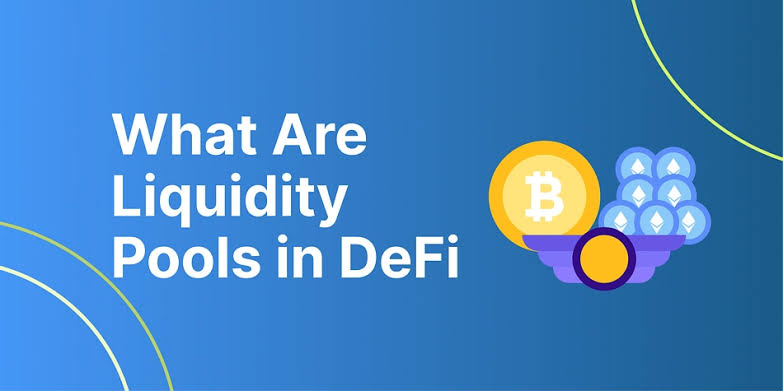
If you have ever used a decentralised exchange, you may have noticed that there is no traditional order book showing a long list of buyers and sellers waiting to match with each other. Instead, many DeFi platforms rely on something called a liquidity pool. Behind the simple “swap” button is a pool of digital assets held by a smart contract and used to facilitate trading.
Liquidity pools are one of the building blocks of decentralised finance. They allow users to contribute assets to a shared pool and, in return, potentially receive a portion of the fees generated by activity. The concept sounds straightforward, but the economics underneath it are more complicated. Anyone considering providing liquidity needs to understand not only how fees are earned, but also how price movements can affect the value of their deposited assets.
For German crypto users exploring DeFi, liquidity pools are worth understanding because they demonstrate both sides of decentralised finance: the opportunity to participate directly in a financial market and the responsibility that comes with doing so.
What Is a Liquidity Pool?
A liquidity pool is essentially a collection of crypto assets locked in a smart contract and made available for a particular financial purpose. In decentralised exchanges, pools are commonly used to allow users to swap one token for another without requiring a conventional centralised order book.
Imagine a pool containing ETH and another token. A trader who wants to exchange one asset for the other interacts with the pool through a decentralised application. The smart contract determines how the trade affects the balances inside the pool according to the protocol’s rules.
This model allows trading to take place without a central company matching every buyer with a seller. Ethereum describes DeFi as an ecosystem in which smart contracts can provide financial services without traditional intermediaries, while different protocols can operate as interoperable building blocks.
The important point is that the pool needs assets available for traders to use. That is where liquidity providers come in.
Where Does the Liquidity Come From?
Liquidity is generally supplied by users who deposit assets into a pool. Depending on the protocol, a liquidity provider may need to supply two assets in a particular ratio.
For example, a pool could contain ETH and a stablecoin. A user contributing liquidity may deposit both assets so that traders can exchange between them. In exchange for making those assets available, the liquidity provider can receive a share of trading fees generated by the pool.
This changes the user’s role in the crypto market. Instead of simply buying and holding an asset, the person is providing infrastructure that other traders can use.
The attraction is obvious: if trading activity is high, fees can potentially generate additional income. But the return is not free. The liquidity provider takes on risks that a normal buy-and-hold investor may not face.
How Does a Decentralised Exchange Use the Pool?
Traditional exchanges often rely on an order book. Buyers place bids, sellers place offers, and the platform’s matching engine connects the two sides.
Many decentralised exchanges use a different mechanism known as an automated market maker, or AMM.
Instead of waiting for a specific buyer and seller to agree on a price, the protocol uses the assets held in the liquidity pool to facilitate swaps. The pricing mechanism adjusts according to the amount of each asset available and the rules programmed into the protocol.
This approach has helped make decentralised trading more accessible because users can interact directly with smart contracts through compatible wallets. Research on decentralised exchanges identifies automated market makers and liquidity pools as important developments in the evolution of on-chain trading.
However, the simplicity visible on the front end hides a more complex economic system underneath.
Why Would Someone Provide Liquidity?
The most obvious reason is the possibility of earning fees.
Whenever traders swap assets through a pool, the protocol may charge a trading fee. A portion of that fee can be distributed to liquidity providers according to the pool’s rules.
For an active market with significant trading volume, this can become an attractive source of potential income. But liquidity providers should not look at the advertised fee rate in isolation.
A pool can generate substantial trading fees while the underlying assets are losing value. In addition, the amount earned by an individual provider depends on factors such as their share of the pool, trading activity and the protocol’s fee structure.
This means “high fees” and “high returns” are not necessarily the same thing.
The Risk Called Impermanent Loss
One of the most important concepts for liquidity providers is impermanent loss.
The name can sound reassuring, but the risk is real.
Impermanent loss can occur when the prices of assets in a liquidity pool change relative to one another. Because the AMM adjusts the composition of the pool as traders buy and sell, the provider may end up holding a different proportion of the two assets than they originally deposited.
Consider a simple ETH/stablecoin pool. If ETH rises sharply relative to the stablecoin, traders may effectively remove some ETH from the pool while adding more stablecoin. The liquidity provider’s position therefore changes as the market price changes.
The provider may still earn trading fees, but those fees need to be weighed against the effect of the changing asset composition.
Academic research on DeFi identifies liquidity-provision risks, including impermanent loss, as an important part of understanding the economic exposure of decentralised financial protocols.
Why a High APY Can Be Misleading
DeFi platforms sometimes advertise attractive annual percentage yields or similar figures.
For newcomers, a large percentage can immediately look like an opportunity.
But the number needs context.
First, the displayed rate can change as market conditions change. Second, some rewards may be paid in volatile tokens. Third, the value of the deposited assets themselves can rise or fall. Finally, the provider may experience impermanent loss or other protocol-specific risks.
A 20% token reward does not necessarily mean that a user’s euro-denominated wealth will increase by 20%.
If the rewarded token loses significant value, the outcome can be very different from the headline figure.
For German users, it is therefore useful to evaluate DeFi returns in euros, not simply in the number of tokens received.
Smart Contracts Add Another Layer of Risk
Liquidity pools depend heavily on smart contracts.
A smart contract is a program deployed on a blockchain that executes according to its programmed rules. Users interact with the contract by submitting blockchain transactions, and the contract can automatically manage assets and execute functions defined in its code.
This automation is one of DeFi’s major advantages, but it also introduces technical risk.
A programming error, exploit or vulnerability can potentially affect funds deposited into the protocol. Even widely used protocols cannot simply be assumed to be risk-free.
This is why checking the protocol’s history, documentation, audits, governance arrangements and security record is important before depositing significant funds.
An audit can reduce certain risks, but it is not an absolute guarantee.
What Should German Users Consider?
Anyone in Germany looking at liquidity pools should consider both the financial and regulatory side of the activity.
The European Union has introduced the Markets in Crypto-Assets Regulation, or MiCA, as a harmonised framework covering many crypto-assets and related services. However, decentralised arrangements do not necessarily fit neatly into the same regulatory categories as conventional crypto-asset service providers. The exact legal treatment can depend on how a protocol, interface or service is structured.
This area is still developing. In 2026, the European Commission is reviewing MiCA’s application and market developments, including through consultations that examine whether the framework remains fit for purpose.
For German users, this means it is unwise to assume that every DeFi platform has the same regulatory protections as a regulated financial service.
A Practical Checklist Before Providing Liquidity
Before depositing funds into a liquidity pool, it is worth answering a few basic questions:
- What two or more assets does the pool contain?
- How does the pricing mechanism work?
- What percentage of trading fees goes to liquidity providers?
- Can the fee rate change?
- What are the risks of impermanent loss?
- Which blockchain does the protocol use?
- What are the transaction and gas costs?
- Has the smart contract been audited?
- How long has the protocol been operating?
- What happens if the protocol experiences an exploit?
- How will the activity affect your tax reporting obligations?
These questions may seem excessive when a DeFi application makes depositing funds look as easy as clicking a button.
That is exactly why they matter.
The user interface can be simple even when the financial product is not.
Is Providing Liquidity Right for Everyone?
Probably not.
Liquidity provision is a more advanced DeFi activity because the user is exposed to several risks simultaneously. The value of the underlying tokens can change, the composition of the pool can shift, trading fees can vary and the smart contract itself can have vulnerabilities.
For someone new to cryptocurrency, simply understanding how a liquidity pool works may be a better first step than immediately depositing funds.
DeFi is built around participation. Users can become lenders, borrowers, traders and liquidity providers rather than simply customers of a financial institution. Ethereum’s DeFi ecosystem describes these applications as programmable financial building blocks that can be combined to create increasingly sophisticated services.
That flexibility is what makes DeFi interesting.
It is also what makes understanding the risks so important.
The Bigger Picture
Liquidity pools may look like a technical solution to a trading problem, but they represent something much broader.
They allow ordinary users to contribute capital directly to a financial market and potentially earn a share of the activity generated by that market. There is no traditional market-maker relationship in the usual sense; instead, software, liquidity and economic incentives work together.
For German crypto readers, the important lesson is not that liquidity pools are good or bad.
It is that DeFi changes the role of the user.
You are no longer simply buying an asset through a platform. You may be providing liquidity, interacting directly with smart contracts and accepting risks that would normally be handled by financial intermediaries.
Understanding that difference is the first step toward making sense of the opportunities—and the risks—inside decentralised finance.