

Imagine being able to lend digital assets, exchange tokens or access financial services without opening a traditional bank account for every transaction. Instead of a bank or broker sitting in the middle, the service is provided through blockchain networks and software known as smart contracts.
That is the basic idea behind decentralised finance, or DeFi.
DeFi has become one of the most important areas of the cryptocurrency industry because it attempts to recreate familiar financial activities—such as trading, lending and borrowing—using blockchain-based infrastructure. Ethereum is currently one of the main foundations for DeFi, with applications built on smart contracts that can operate continuously and interact with one another.
For people in Germany, DeFi is particularly interesting because it sits at the intersection of cryptocurrency, financial technology and regulation. At the same time, it is an area where the potential benefits can be accompanied by significant technical and financial risks.
A Different Way of Looking at Financial Services
Traditional finance depends heavily on intermediaries. If you want a mortgage, you approach a bank. If you want to trade shares, you normally use a broker or financial platform. If you want to transfer money internationally, a bank or payment provider may handle the transaction.
DeFi takes a different approach.
Instead of putting all of the responsibility in the hands of one institution, certain financial functions can be handled by blockchain protocols and smart contracts. These are programs deployed on a blockchain that execute according to predefined rules. Users interact with them through compatible wallets and applications rather than necessarily dealing with a traditional financial company.
This does not mean DeFi has eliminated trust. The type of trust has changed. Instead of relying entirely on a bank’s internal systems, users may be relying on blockchain infrastructure, smart-contract code, economic incentives and the security practices of the protocol they choose.
That distinction is important because software can have vulnerabilities, and decentralisation does not automatically make a financial product safe.
What Can People Actually Do With DeFi?
The term DeFi covers a broad collection of applications rather than one particular product.
One of the most established areas is decentralised trading. Decentralised exchanges allow users to swap certain digital assets through blockchain-based protocols rather than placing orders through a conventional centralised exchange.
Another major area is crypto lending and borrowing. Users can supply assets to lending protocols and potentially receive returns, while other users can borrow against collateral. Some DeFi lending systems operate through liquidity pools, where deposited assets are made available to borrowers according to the protocol’s rules.
There are also liquidity-provision systems, derivatives, synthetic assets, staking-related products and automated strategies. This variety is one reason DeFi can appear confusing to newcomers. Two applications may both be described as “DeFi” while having completely different purposes and risk profiles.
Why Smart Contracts Matter
Smart contracts are at the centre of much of the DeFi ecosystem.
In traditional finance, a financial institution employs people, databases and internal software to manage transactions and enforce contractual processes. In DeFi, some of these functions can be encoded into blockchain-based software.
For example, a lending protocol can define how deposits are supplied, how borrowing works, how collateral is monitored and what happens if a position becomes undercollateralised. Once deployed, the contract can execute according to its programmed logic without someone manually processing every transaction.
This automation is one of DeFi’s biggest attractions.
It can make financial applications available around the clock and allow different protocols to interact with one another. Ethereum describes this broader ecosystem as an environment in which DeFi products can be combined and used as building blocks for other applications.
However, automation has an obvious downside: if the underlying code contains a serious vulnerability, the consequences can be difficult to reverse.
Why DeFi Looks Different From a German Bank Account
A German consumer is accustomed to a financial system built around regulated institutions. Banks operate within established legal and supervisory frameworks, and customers generally know which company is responsible for providing a service.
DeFi can feel very different.
A user may interact with a decentralised application, connect a crypto wallet and approve transactions directly. There may be no conventional account manager, branch or customer-support department capable of reversing a transaction.
This can give users greater control over their assets, but it also places more responsibility on the individual.
If a user approves a malicious transaction, sends assets to the wrong address or interacts with a vulnerable protocol, the outcome may not resemble a conventional banking error where a payment can sometimes be investigated or reversed.
That is why self-custody and transaction security are such important concepts in DeFi.
Where Do Returns Come From?
One reason DeFi attracts investors is the possibility of earning returns on digital assets.
Returns can come from several sources, including lending activity, trading fees, staking mechanisms or incentives offered by particular protocols.
But a high advertised yield should never be interpreted as free money.
A return exists because someone or something is taking risk, providing liquidity, paying fees or receiving newly issued incentives. The source of the yield matters.
For example, a protocol offering an unusually high reward in its own token may produce an attractive headline rate, but the value of that token can change dramatically. A nominally high yield can therefore look very different when measured in euros.
For a German user, evaluating DeFi returns in euro terms is particularly important. Earning more tokens does not necessarily mean becoming wealthier if the underlying assets fall substantially in value.
The Risks Are Real
DeFi’s openness is one of its strengths, but it is also one of its biggest risks.
Smart-contract vulnerabilities can lead to the loss of funds. Market volatility can cause collateral values to fall rapidly. Liquidity can disappear during periods of stress. Price oracles, bridges and other infrastructure can introduce additional technical dependencies.
There is also the risk of misunderstanding how a protocol actually works.
A product may look similar to a savings account because it advertises an annual percentage yield, but the underlying risk can be completely different from depositing money with a conventional bank.
Academic research on DeFi has highlighted how complex protocol designs and incentive mechanisms can make risk assessment difficult, particularly in lending systems.
What About Regulation in Germany?
This is an important area to watch.
The European Union has established the Markets in Crypto-Assets Regulation (MiCA), creating a harmonised framework for many crypto-assets and related services. However, DeFi does not fit neatly into the same regulatory categories as conventional crypto-asset service providers, and the regulatory treatment can depend heavily on how a particular project or service is structured.
The European Commission is currently reviewing MiCA and has opened consultations on its application and market developments in 2026.
For German users, this means regulatory developments should be followed carefully rather than assuming that every DeFi application has the same legal status as a regulated exchange or financial institution.
Should Beginners Stay Away From DeFi?
Not necessarily, but beginners should approach it differently from buying a well-known cryptocurrency through a conventional platform.
The first step should be education.
Before connecting a wallet to a DeFi application, users should understand what the protocol does, what assets are involved, where the advertised yield comes from, what fees apply and what could cause a loss.
It is also worth checking whether the protocol has undergone credible security reviews, although an audit should never be treated as a guarantee that a smart contract is safe.
Most importantly, users should never commit money they cannot afford to lose simply because a DeFi product promises an attractive return.
DeFi Is Still Evolving
The most interesting thing about DeFi is not necessarily the latest yield or token.
It is the experiment itself.
For the first time, financial services can be built as interconnected software running on public blockchain infrastructure. Lending, trading, liquidity and other financial functions can become programmable components that developers combine into new applications.
That does not mean DeFi will replace banks.
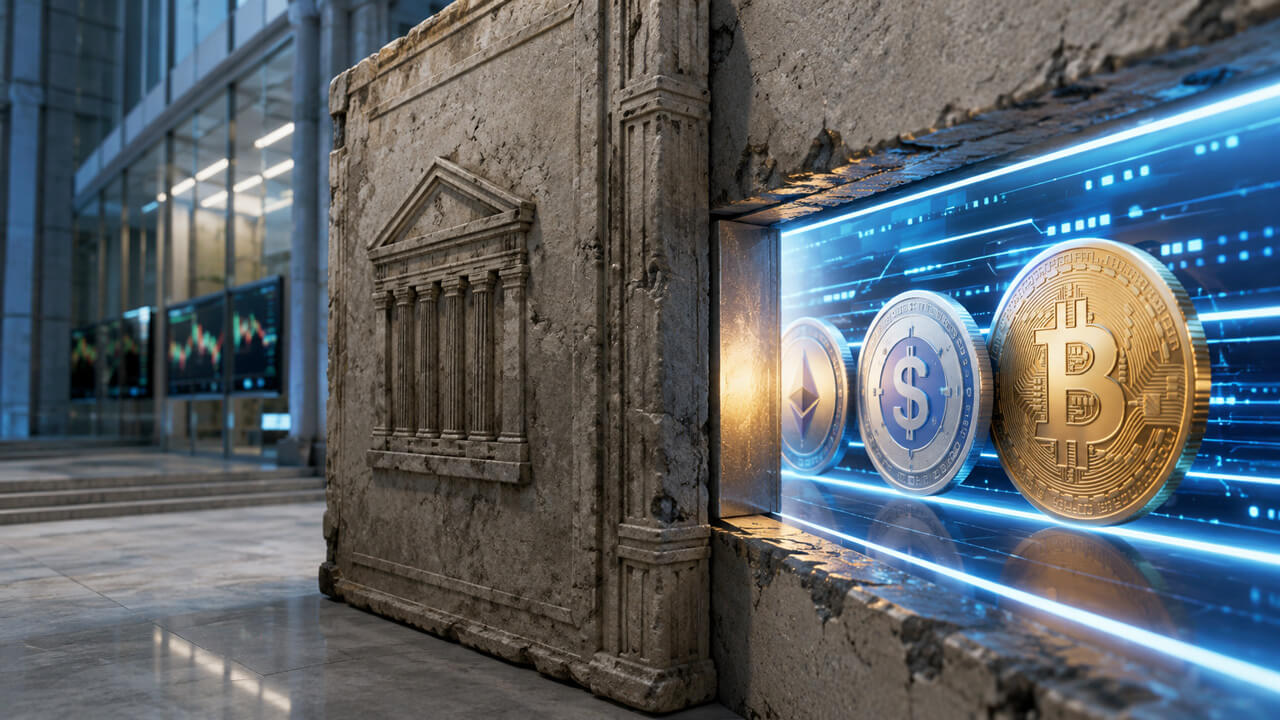
Traditional finance has advantages in areas such as regulation, consumer protection, established infrastructure and legal accountability. DeFi has different strengths, particularly openness, programmability and global accessibility.
The two systems may increasingly influence one another rather than simply compete.
For German crypto readers, that makes DeFi worth understanding even if they never use a decentralised application themselves.
The technology is changing how people think about financial services—and the more important question is no longer whether DeFi is simply “the future of finance.”
It is which parts of decentralised finance can actually deliver useful financial services while making their risks understandable enough for ordinary users to navigate.