



When people hear the word “mining” in connection with Bitcoin, the image can be confusing.
There are no underground tunnels, no machines digging through rock and no physical coins waiting to be discovered.
Bitcoin mining is entirely digital.
It is a process that helps confirm transactions, secure the Bitcoin network and introduce new bitcoins according to the rules built into the protocol. Behind the scenes, specialised computers compete to perform a difficult computational task, while the rest of the network checks their work.
For anyone following Bitcoin from Germany, understanding mining is useful because it explains one of the most important differences between Bitcoin and conventional money.
Bitcoin Needs a Way to Agree
Imagine thousands of computers around the world maintaining a shared record of Bitcoin transactions.
A difficult question immediately appears:
Who decides which transactions are legitimate and which version of the transaction history is correct?
In a conventional financial system, a bank or central institution maintains the relevant records.
Bitcoin takes a different approach.
It uses a combination of cryptography, distributed networking and proof-of-work to allow participants to agree on the state of the blockchain without relying on one central administrator.
Mining is a major part of that system.
What Exactly Does a Miner Do?
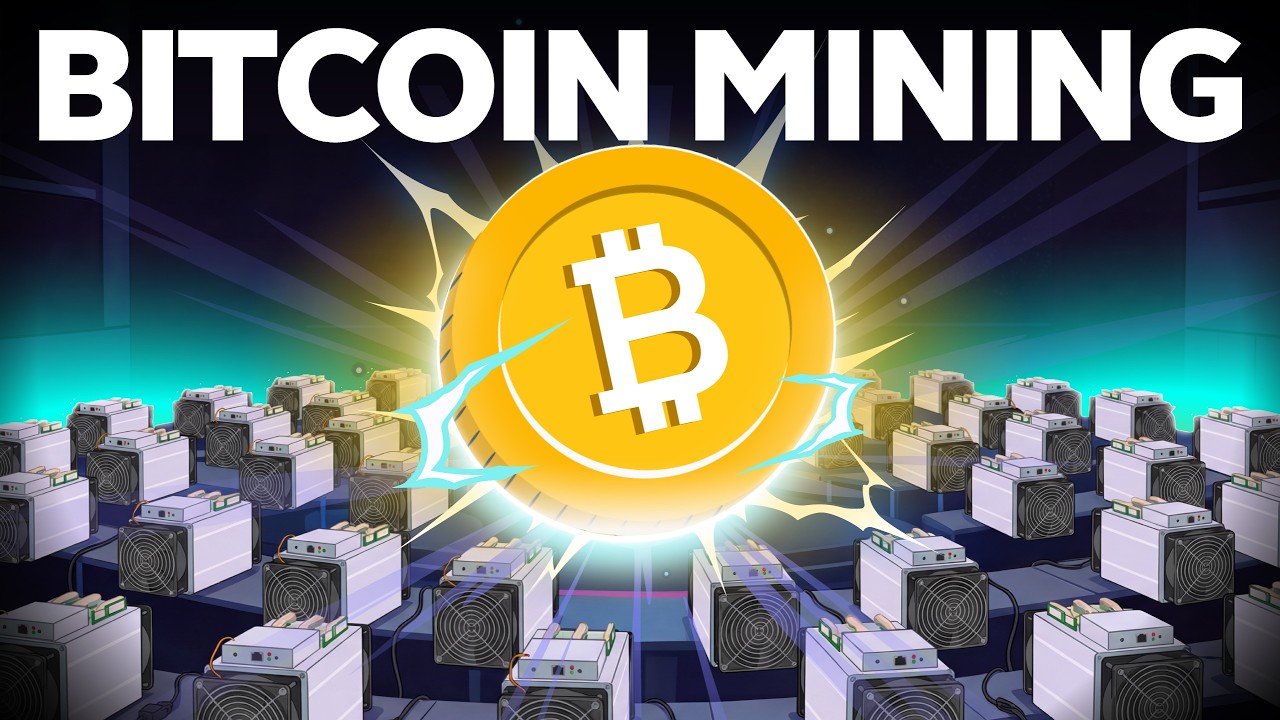
Bitcoin miners collect valid pending transactions and attempt to add them to a new block.
To do this, mining hardware repeatedly performs calculations in an effort to find a result that satisfies the network’s current difficulty requirement.
The process is competitive.
Many miners can be working simultaneously, but normally only one successful miner gets to add a particular block to the blockchain.
Once a miner produces a valid block, it is broadcast to the network.
Other Bitcoin nodes then verify it.
If the block follows the protocol’s rules, it can be accepted and added to the blockchain.
This creates a chain of confirmed blocks containing Bitcoin transaction history.
Why Make Mining Difficult?
At first glance, making the process computationally expensive may seem inefficient.
There is a reason for it.
Proof-of-work makes it costly to attempt to manipulate the blockchain.
Someone trying to rewrite a significant portion of Bitcoin’s transaction history would need enormous computing resources and energy to compete with the existing network.
The difficulty therefore acts as a form of economic security.
A participant cannot simply announce a new transaction history and expect everyone else to accept it.
They have to produce work that satisfies the network’s rules.
Other participants can then verify the result relatively efficiently.
That asymmetry is important.
Creating the proof requires significant computation, while checking it is comparatively straightforward.
Where Do New Bitcoins Come From?
Mining also has a monetary function.
Successful miners can receive a block reward under Bitcoin’s protocol rules.
The reward has historically included newly created bitcoin as well as transaction fees from transactions included in the block.
This is how new bitcoins enter circulation.
However, the number of new bitcoins created through mining does not remain constant.
Bitcoin’s protocol includes periodic reductions in the block subsidy, commonly known as halvings.
Over time, these reductions decrease the rate at which new bitcoins are introduced.
Eventually, the issuance of new bitcoin through the block subsidy is designed to approach zero.
The total supply is capped at 21 million bitcoins.
This is very different from conventional monetary systems, where the supply of a national currency can change according to monetary policy and economic conditions.
Mining Is a Competition
Bitcoin mining is not a simple lottery with equal chances for everyone.
The more computational power a miner contributes, the greater the miner’s probability of finding the next valid block.
This has led to the development of highly specialised mining hardware and large-scale mining operations.
Modern Bitcoin mining is therefore a competitive industry.
Miners must consider hardware costs, electricity prices, cooling, maintenance, infrastructure and the expected value of mining rewards.
This makes electricity particularly important.
Why Energy Is Part of the Bitcoin Debate
Bitcoin mining consumes electricity because proof-of-work requires computing power.
This has become one of the most debated aspects of Bitcoin.
Critics argue that the energy consumption can be environmentally costly, particularly when mining relies heavily on carbon-intensive electricity.
Supporters argue that the energy question needs to be considered alongside the security and monetary functions provided by the network. They also point to miners using renewable or otherwise underused energy sources in some locations.
The reality is more complicated than a simple “good” or “bad” label.
The environmental impact of Bitcoin mining depends on factors such as the electricity sources being used, the efficiency of mining equipment and how mining operations respond to changing energy markets.
For German readers, this debate is particularly relevant because Germany has long had a strong public discussion around energy costs, renewable generation and electricity infrastructure.
Does Mining Control Bitcoin?
This is a common misunderstanding.
Miners play an important role, but they do not have unlimited control over Bitcoin.
Bitcoin nodes independently verify whether blocks and transactions follow the network’s consensus rules.
A miner could attempt to produce a block containing an invalid transaction, but other nodes can reject it.
In this way, miners provide the computational work while the wider network checks whether their work follows the rules.
This separation is one of the important features of Bitcoin’s architecture.
No single miner can simply decide to change the rules for everyone else.
Why Are Miners Paid?
Mining requires real-world resources.
Hardware costs money.
Electricity costs money.
Buildings, cooling systems, network connections and maintenance all require investment.
Without some form of economic incentive, there would be less reason for participants to spend these resources securing the network.
Bitcoin therefore combines technological rules with financial incentives.
Miners compete to earn block rewards and transaction fees.
The system attempts to make honest participation economically attractive while making attacks expensive.
This is an example of how Bitcoin combines computer science with economics.
The network is not secured by technology alone.
It is also supported by incentives.
What Happens When Bitcoin’s New Supply Eventually Stops?
This is an interesting long-term question.
The block subsidy is designed to decline over time.
Eventually, miners will no longer receive newly created bitcoins as part of the block reward. Their income will increasingly depend on transaction fees.
That does not necessarily mean Bitcoin mining would stop.
If the network continues to have meaningful transaction activity, users can pay fees to have transactions included in blocks.
Whether those fees will provide sufficient incentives for miners in the distant future is an ongoing subject of discussion.
It is one of the many long-term questions surrounding Bitcoin’s economic model.
Mining Is Not the Same as Buying Bitcoin
Someone interested in Bitcoin does not need to become a miner.
Most individual users interact with Bitcoin by purchasing it, receiving it, sending it or holding it through a wallet or custodial service.
Mining is an infrastructure activity.
It requires specialised equipment and access to competitive energy costs, making it very different from simply owning Bitcoin.
For beginners, this distinction is useful.
You can understand how Bitcoin mining works without having any intention of operating mining hardware yourself.
Why Mining Matters to the Average User
A person sending Bitcoin from Germany to another country may never think about mining.
They simply see a transaction being processed.
But mining is part of what allows that transaction to become part of Bitcoin’s permanent transaction history.
It helps prevent arbitrary changes to the blockchain.
It contributes to network security.
It creates a mechanism for ordering transactions.
And it provides the process through which new bitcoins are issued according to the protocol.
In other words, mining is happening in the background even when ordinary users never see it.
The Bigger Idea Behind Mining
Bitcoin mining is often reduced to one sentence: “Computers solve complicated problems to earn Bitcoin.”
That description is not completely wrong, but it misses the important part.
Mining is really a mechanism for coordinating a decentralised financial network.
There is no central bank deciding which Bitcoin transactions enter the next block.
There is no single administrator maintaining the global ledger.
Instead, a combination of miners, nodes, cryptographic rules and economic incentives creates a system where participants can independently verify what is happening.
That is the deeper reason mining matters.
For German readers trying to understand Bitcoin beyond the daily price, this is one of the most useful pieces of the puzzle.
Bitcoin is not simply a digital coin sitting inside an app.
It is a network with an economic system underneath it, and mining is one of the mechanisms that keeps that system operating.
The price may change from one day to the next.
Headlines may come and go.
But beneath those movements, miners around the world continue performing the computational work that helps keep Bitcoin’s blockchain secure and functioning.